When you see “24/7 support” listed on a Supported Independent Living vacancy, it can mean different things depending on the provider. For participants with complex needs and for the families and Support Coordinators who support them understanding exactly what overnight and around-the-clock support looks like is critical before choosing a SIL home. This guide breaks down what 24/7 SIL support actually involves, the difference between active overnight and sleepover support, and how to know which model is right for you.
In this article:
- What 24/7 support means in a SIL context
- Active overnight vs sleepover support and why it matters
- Support ratios explained
- How to know what level of support you need
- What to ask a SIL provider before you commit
What Does 24/7 Support Actually Mean in SIL?
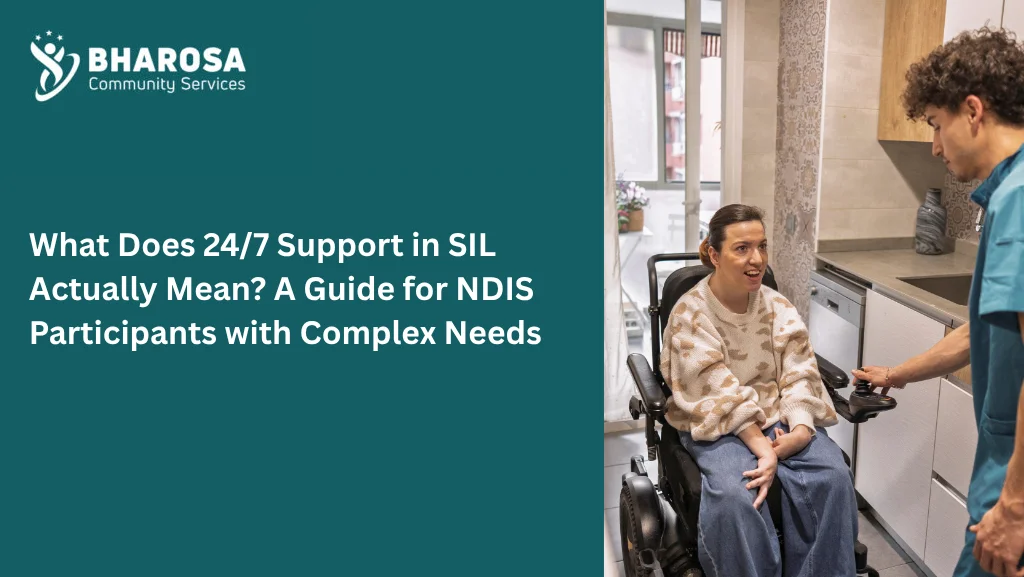
In a SIL setting, 24/7 support means a trained support worker is available in the home at all times day, evening, and through the night. It does not necessarily mean a worker is actively assisting you every minute of the day. Rather, it means support is always accessible when you need it, without delay.
For participants with complex or high support needs, this continuity is essential. It removes the risk of gaps in care, provides safety during emergencies, and allows participants to live at home rather than in a clinical or institutional environment.
24/7 support is funded through your NDIS plan under the SIL funding line. The cost reflects the staffing required to maintain that level of coverage across all hours of the day, every day of the week.
24/7 SIL support typically includes:
- Morning and evening personal care routines
- Meal preparation and medication assistance
- Support with mobility, transfers, and hygiene
- Overnight monitoring or active assistance
- Community access and social participation support
- Behaviour support and emotional regulation assistance
Active Overnight Support vs Sleepover Support. What’s the Difference?
This is one of the most important distinctions to understand when choosing a SIL home, and it directly affects both your safety and your NDIS funding.
Active overnight support means a support worker is awake and working throughout the night. They are available to assist with personal care, seizures, repositioning, distress, or any other need that arises. This is the highest level of overnight support and is appropriate for participants who frequently need assistance during the night.
Sleepover support means a support worker sleeps at the property and can be woken if needed. They are not continuously awake and working. This model suits participants who rarely need overnight assistance but benefit from knowing someone is present in the home.
The NDIS funds these two models very differently. Active overnight attracts a higher hourly rate because the worker is classified as working, not resting. Sleepover attracts a flat overnight allowance. Your Support Coordinator and provider will help determine which model is appropriate based on your documented support needs.
Questions to ask your provider about overnight support:
- Is overnight support active or sleepover?
- What is the waking protocol if I need help during the night?
- How many staff are rostered overnight across the home?
- Has this support model been approved in my NDIS plan?
Understanding Support Ratios in SIL
Support ratios describe how many participants one support worker is responsible for at a given time. They are a key factor in the quality and responsiveness of your day-to-day support.
A 1:1 ratio means one support worker dedicated solely to you. This is appropriate for participants with the highest support needs, complex behaviours, or medical requirements that demand constant individual attention.
A 1:2 ratio means one support worker supporting two participants at the same time. This is common in shared SIL homes where housemates have compatible needs and routines.
A 1:3 ratio means one support worker supporting three participants. This is typically appropriate for participants with lower support needs who are more independent in their daily routines.
In many SIL homes, ratios shift across the day. You might receive 1:1 support during your morning routine, move to 1:2 through the day, and then have a sleepover support worker overnight. Your NDIS-approved Roster of Care outlines exactly how support hours and ratios are allocated.
Ratio quick reference:
| Ratio | Best suited for |
|---|---|
| 1:1 | High/complex needs, full-time individual support |
| 1:2 | Moderate needs, compatible housemate routines |
| 1:3 | Lower support needs, high independence |
How Do You Know What Level of Support You Need?
The assessment process for SIL support intensity is typically led by your Support Coordinator, alongside an Occupational Therapist and sometimes a behaviour support practitioner. They will document your daily support requirements in detail, which forms the basis of your Roster of Care submission to the NDIS.
Key factors that influence support intensity include your physical support needs, communication requirements, behaviour support needs, medical conditions, and how much you can do independently at different times of day. The NDIS uses this evidence to approve the level of SIL funding that matches your genuine needs.
It is important to be thorough and honest in this assessment. Under-reporting your needs can result in a support model that does not keep you safe. Your Support Coordinator’s role is to advocate for the right level of support based on your actual situation.
Factors that typically indicate a need for 24/7 active support:
- Frequent overnight needs such as repositioning, seizures, or personal care
- Complex behaviours that require immediate de-escalation
- Medical conditions requiring monitoring or intervention at night
- High fall risk or mobility limitations
- Limited ability to call for help independently
24/7 SIL Support at Bharosa’s Morayfield Vacancy
Bharosa Community Services’ SIL vacancy in Morayfield offers 24/7 support including active overnight staffing. The home currently has three vacancies and can support participants with low, moderate, or high support needs, with flexible ratios of 1:1, 1:2, and 1:3 available depending on individual NDIS plans.
Our support team is experienced in complex care, culturally diverse backgrounds, and person-centred support planning. We work closely with Support Coordinators and families to ensure every participant’s Roster of Care accurately reflects their needs before they move in.
If you are a Support Coordinator looking for an appropriate SIL placement, or a participant or family researching options in Brisbane’s Moreton Bay region, we encourage you to view the full property listing or submit a referral through our online form.
Conclusion
24/7 support in SIL is not a single fixed model it covers everything from active overnight staffing to sleepover arrangements, across a range of support ratios that change throughout the day. Understanding the difference is essential to choosing a SIL home that genuinely meets your needs and is funded correctly in your NDIS plan.
If you have questions about what level of support is right for you or a participant you work with, contact Bharosa Community Services we are happy to talk through your situation and explain how our Morayfield home can help.